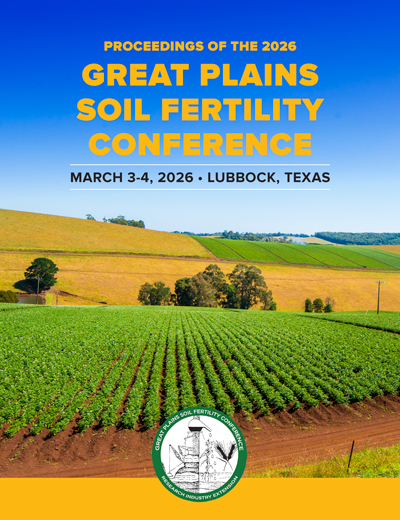
Conference Proceedings Available!

 
The 2024 Great Plains Soil Fertility Conference Proceedings Book is now available! Click the link below to view the full document!
 
GPSFC Proceedings - 2024.pdf

Proceedings

Find matching any: Reset
Oral
Add filter to result:
Authors
Abdelhamid, M
Abulobaida, M
Abunyewa, A
Adamson, D
Ahuja, L
Aiken, R
Akporsoe, P
Alford, J
Alghamdi, R
Alwang, J
Andrade Leite Mengez, G
Andrews, S
Annis, D
Archer, D
Archibequet, S
Armbruster, J
Armstrong, R
Arnall, B
Assefa, Y.M
Atencio, S
Aula, L
Baath, G
Baber, K
Bainard, L
Baker, M
Ball, J
Baltensperger, D
Barnard, D.M
Bartolo, M
Bauder, S
Bauer, A
Baughman, T
Bausch, W
Bawa, A
Bean, B
Beck, D
Benajmin, J
Benjamin, J
Beres, B
Berrada, A
Bevers, S
Black, A
Blaylock, A
Bly, A
Boogades, N
Booker, J
Boon Goh, T
Borch, T
Bordovsky, J
Bourgault, M
Bradbury, G
Brandt, A.D
Brandt, S
Brockmueller, B
Bronson, K
Burgener, P
Burke, J
Cade-Menun, B
Calderon, F
Calderón, F
Caldwell, R
Cardon, G.E
Carr, P
Carson, Z
Carstens, G
Carver, E
Chen, C
Cihacek, L
Cipra, J
Clark, J
Clayton, G
Coles, K
Correira, A
Cotrufo, F
Coyle, K
Creech, C
D'Adamo, R
D'Agati, K
Daly, E
Davis, J
DeLaune, P
DeSilva, S
Deibert, E
Del Grosso, S
Del Grosso, S.J
Delgado, J
Delgado, J.A
Derner, J
Dhuyvetter, K
Dobermann, A
Doesken, K
Donoho, T
Doran, J
Drescher, G
Dumler, T
Easterly, A
Eghball, B
Eigenberg, R
Ela, S
Elliott, A
Elliott, J
Ellsworth, J
Enciso, J
Engel, R
Eriksmoen, E
Etemadi, F
Etesami, M
Evans, B
Fairchild, D
Falk, J
Fanning, C
Farahani, H
Ferdinand, L
Ferguson, R
Fixen, P
Flore, N
Floyd, B
Fordyce, S
Foster, A
Foster, J
Fouts, W
Francis, D
Franck, B
Franck, W
Franzen, D
Frasier, M
Freeman, K
Funderburg, E
Gallagher, P
Gan, Y
Gangloff, W
Gao, X
Garza, R
Gehl, R
Gelderman, R
Gerwing, J
Ghimire, D
Gill, R
Giordano, N
Godin, R
Godsey, C
Goettl, B
Goos, J
Goos, R
Gordon, B
Grant, C
Green, C
Griffith, D
Grunberg, J
Grusak, M.A
Guo, W
Guttieri, M
Haag, L
Haby, V
Hagele, J
Hall, L
Halstead, E
Halvorson, A
Hansen, N
Hanson, J
Hao, X
Harapiak, J
Harold, J
Harold, S
Harrold, S
Hatfield, J
He, H
Heckman, K
Heer, W
Henry, B
Hergert, G
Herhalo, K
Herman, J
Hernandez-Ramirez, G
Holloway, R
Holman, J
Holman, J.D
Holzapfel, C
Hopkins, B
Hopkins, B.G
Hough, H
Hultgreen, G
Hussain, T
Inman, D
Ireland, S
Irvine, B
Iversen, B
Iversen, K
Jabro, J
Jackson, G
Jacobsen, J
Jaenich, B.R
Janssen, K
Jensen, J
Jifon, J
Jin, V
Jin, V.L
Johnson, B
Johnson, D
Johnson, G
Johnson, S.K
Johnston, A
Johnston, C
Jones, C
Jones, J
Jones, O
Jonhson, M
Kafle, A
Karamanos, R
Karimi Dehkordi, R
Karn, R
Kastens, T
Keeling, W
Keshavarz Afshar, R
Khosla, R
Kim, J
Kim, K
Kimura, E
Klein, B
Klimchuk, K
Kluitenberg, G
Koch, B
Koeshall, S
Kovar, J
Krupinsky, J
Kucey, R
Kuester, C
Kumar, S
Kutcher, R
Lafond, G
Lamb, P
Lamond, R
Larney, F
Lawley, J.R
Lawson, V
Leikam, D
Lemunyon, J
Lenssen, A
Leonard, A
Lester, G
Lewis, K
Li, Z
Liebig, M
Lollato, R
Lombi, E
Lyon, D
Maddux, L
Maharjan, B
Malapati, A
Malhi, S
Malinowski, D
Mallinowski, D
Mankin, K.R
Manter, D
Manter, D.K
Marcillac, N
Martin, G
Martin, V
Mason, S
Massey, J
Matschek, R
Maxwell, K
May, W
McBeath, T
McConkey, B
McCulloch, M
McDonald, M
McLaren, D
McLaughlin, M
McMaine, J
McVay, K
Mengel, D
Merrill, S
Mielke, L
Mikha, M
Mikha, M.M
Miller, P
Miller, R
Miner, G
Miner, G.L
Mitchell, R.B
Mohr, R
Monreal, M
Mooleki, S
Moore, E
Mortvedt, J
Mosier, A
Motal, F
Mowrer, J
Mubvumba, P
Muir, J
Mullen, R
Multer, W
Mungaas, A
Murphy, L
Nakabuye, H
Nance, S
Nelson, J
Nelson, N
Nesmith, D
Nichols, K
Nielsen, D
Nielsen, N
Nielsen, R
Noland, R
Norton, J
Norton, S
Norton, U
Nyborg, M
Obour, A
Obour, A.K
Olsen, S
Olson, B
Onken, A
Osborne, L
Osborne, S
Ostlie, M
Owens, J
Pabuayon, I
Patel, S
Penas, E
Peterson, G
Pham, T
Pikul Jr., J
Pinchak, W
Poisson, D
Pokharel, D
Polkinghorne, A
Popp, M
Porter, D
Poss, D
Power, J
Presley, D
Pritchett, J
Proulx, M
Qiao, X
Quinn, D
Rahmani, E
Rakkar, M
Ramos do Prado, M
Raun, W
Rector, K
Reed, V
Reich, R
Reule, C
Rickertsen, J
Ridley, A
Riedell, W
Ritchie, G
Riveland, N
Roberts, D
Roberts, T
Robinson, D
Rohde, J
Roozeboom, K
Roozeboom, K.L
Rops, B
Roth, R
Ruiz Diaz, D
Sadras, V
Sainju, U
Saldana Haworth, I
Sander, D
Santos, E
Sarfaraz, Q
Schepers, J
Schierer, R
Schipanski, M.E
Schlegel, A
Schmer, M
Schmer, M.R
Schmidt, E
Schmidt, J
Schmitt, M
Schneekloth, J
Schoenau, J
Schroeder, P
Schultz, K
Schwartz, R
Schweeissing, F
Sexton, P
Shanahan, J
Shapiro, C
Sharma, A
Sharry, R
Shaver, T
Sherrod, L
Siebecker, M
Sij, J
Silva, J
Simao, L
Simon, L
Simon, L.M
Sims, A
Singh, M
Skogley, E
Slaton, N
Smartt, A
Smika, D
Smith, L
Smith, N
Snell, K
Solie, J
Souza, M
Spackman, J
Stacey, S
Steinke, K
Stevens, B
Stewart, C
Stewart, C.E
Stewart, W
Stichler, C
Stone, L
Stone, M
Sutradhar, A
Taber, H
Tanaka, D
Tarkalson, D
Thomason, W
Tindall, T
Tokarchuk, J
Tollefson, D
Tomlinson, P
Trostle, C
Truman, C
Ulrich, D
Unger, P
Valencia, H
Varvel, G
Vigil, M
Villacis, A
Villacis-Aveiga, A
Vocasek, F
Volkman, M.M
Waddell, J
Walker, W
Walley, F
Walters, D
Wang, Z
Ward, J
Ward, R
Washburn, K
Waskom, R
Weiseth, B
Westerman, R
Westfall, D
Whitney, D
Wick, A
Wienhold, B
Wilhelm, W
Williams, C
Williams, J
Willson, T
Wollenhaupt, N
Woodard, H
Woodbury, B
Wortmann, C
Wright, A
Wright, S
Yabaji, R
Yost, M.A
Zabinski, C
Zhou, S
Zimbrunnen, J
de Jong, E
van Diepen, L.T
Topics
Soil Management
N/Irrigation
Soil Fertility
Cover Crops and Nutrients
N Management
General
Environment and Soil
Nitrogen Management
Conservation Impacts on Soil Health
Nutrient Management and Analysis
Student
General
Student
Type
Oral
Year
2020
2004
2006
2008
2021
2022
2024
1986
2026
Home » Type » Results

Type

Filter results27 paper(s) found.

1. Effects of Fertilizer Nitrogen Management on Biomass, Oil, and Nitrous Oxide Emissions in Peppermint in Nebraska Panhandle

Peppermint (Mentha pipperita) is an aromatic perennial herb that contains aromatic oil, primarily menthol. Irrigated peppermint production requires large nitrogen (N) input, which is often higher than for irrigated corn. Therefore, if not managed properly, mint production has a high potential for N losses, including nitrous oxide (N2O) emissions. Nitrous oxide is a major greenhouse gas and the most important ozone-depleting emission. Increasing N2O emissions fro... B. Maharjan, S. Desilva

2. Composted Manure Impacts on Organic Wheat Production in the Northern Great Plains

Montana leads the nation in organic production of small-grain crops including wheat (Triticum spp.). A major challenge faced by dryland farmers when growing wheat organically is supplying adequate N for optimum wheat yield and quality. A onetime application of composted manure at four rates (0, 5.6, 11, and 22 tons/acre) vs. annual applications of urea based on soil test results when growing wheat in wheat/fallow and wheat + biennial sweetclover [(Melilotus officinalis&... P. Carr, M.M. Volkman

3. Combined Nitrogen with Magnesium or Zinc Effects on Sugarbeet Yield Sucrose Concentration, and Nutrient Uptake Under Conventional and No-till Systems

Sugar beet (Beta vulgaris L.) is an important cash crop in the Lower Yellowstone River valley. Fertility, especially nitrogen (N) fertilizer, management is critical for sugar beet yield and sucrose concentration.  While farmers are switching from a conventional tillage method to a no-till system for sugar beet cultivation, nitrogen (N) fertilizer application timing might need to be adjusted. Furthermore, micronutrients may enhance sugar beet yield and sucrose concentration. A tw... C. Chen, M. Etesami, M. Abdelhamid

4. Long-term Tillage with Winter Wheat Grain Yield in Dryland Cropping System

Long-term studies are important to improve our understanding and evaluate the sustainability of management practices while mitigating climate change. This study evaluated the winter-wheat grain yield stability under long-term tillage practices. Yield stability was assessed using squared deviation from regression (S2d). This study of winter wheat-fallow rotation was established in 1970 within the High Plains Agricultural Laboratory (HPAL) near Sidney, Nebraska (NE) on Duroc... M. Mikha, C. Creech, L. Aula, A. Easterly

5. Dual-purpose Cover Crop and Occasional Tillage Effects on Crop Yields and Soil Properties in a No-tillage Wheat-sorghum-fallow Rotation

Replacing fallow with dual-purpose cover crops (CCs) could enhance soil health and increase cropping system profitability when CCs are grazed or hayed. Grazing and/or haying CCs can provide an economic benefit to offset potential lost revenue when grain crop yields are decreased after CCs in dry years. However, producers are concerned about the potential for root-limiting soil compaction following grazing on no-till (NT) fields, which could limit subsequent grain crop yields and require tilla... L. Simon, A. Obour, J. Holman, S.K. Johnson, K. Roozeboom

6. Soil Properties and Winter Wheat Nutrient Uptake As Affected by Long-term Tillage and Nitrogen Fertilization

Knowledge gained on the long-term effects of crop management practices on soil fertility is critical in developing nutrient management strategies to optimize crop yields and environmental sustainability in semi-arid cropping systems. This study examined the long-term effects of nitrogen (N) fertilizer management and tillage intensity [conventional tillage (CT), and no-tillage (NT)] on soil properties and nutrient uptake in a dryland wheat-sorghum-fallow cropping system. Results showed winter ... A. Obour, J. Holman, L. Simon, Y.M. Assefa

7. Lime Management in the Semi-arid Regions of the US

Soil acidity is increasing in the semi-arid regions of the US; however, questions exist about the efficacy of different liming products to raise soil pH and how long the lime benefits last. Therefore, we conducted two studies: 1) To monitor the efficacy of three liming products: sugarbeet lime (tilled and non-tilled), prilled lime (seed-placed), and aglime (tilled) to improve soil pH and crop yields at two sites in Montana and 2) To evaluate how different sugarbeet lime rates perform to mitig... M. Rakkar, C. Jones, P. Miller, K. Mcvay, R. Engel

8. Nitrogen Management in Semi-arid Conservation Cotton Production Systems

The Southern High Plains (SHP) region of Texas is one of the largest cotton-producing regions in the United States. Cotton production is hindered by climatic conditions and wind erosion, but attempts have been made to adopt conservation management practices like cover crops and crop rotations to limit these effects. Conservation management practices can reduce a soil’s susceptibility to wind erosion, but their adoption has been limited on the SHP due to producers’ concerns regardi... J. Burke, K. Lewis, W. Keeling, W. Keeling

9. Developing Nitrogen and Phosphorus Fertigation Strategies in Cotton

Subsurface drip irrigation (SDI) is becoming a popular option for maximizing the water use efficiency of cotton (Gossypium hirsutum), especially in semi-arid environments of the Midsouth and Western United States. In the Texas High Plains where underground water resources from the Ogallala Aquifer are rapidly declining, there is increased adoption of water conservation technologies like center pivot and drip irrigation. In addition to increased water efficiency, drip irrigation allow... K. Lewis, H. Valencia, T. Roberts, J. Burke, G. Ritchie

10. Relationship Between Soil Health and Nutrient Availability in Semi-arid Cotton Production

The use of conservation management practices, like cover crops and no-tillage, is common in semi-arid cropping systems to reduce wind erosion. However, the use of these practices can also reduce cotton lint yield. The purpose of this study was to determine the impact of nitrogen (N) management in conservation cropping systems to increase cotton lint yield. Two experiments were conducted at the Agricultural Complex for Advanced Research and Extension Systems in Lamesa, TX, USA. The first exper... J. Burke, K. Lewis, J. Foster

11. Cover Crops in Semi-arid Dryland Winter Wheat (Triticum Aestivum, L.) Fallow Rotation, a Farmer Collaboration Study

Winter wheat (Triticum aestivum, L.) (WW) is a primary dryland crop in semi-arid southeastern Wyoming. Incorporating cover crops (CC) to a WW-fallow rotation can help improve soil health. Local producers have been exploring the possibilities of using CC, but little is known about the CC impacts on soil moisture, plant available nitrogen (N) and competition with weeds in this region. A collaborative study with two dryland organic WW producers was launched in 2020. FARM 1 was planted to a CC mi... E. Moore, U. Norton

12. Advancing Precision Nitrogen Management in Agriculture: a Multifaceted Approach

Advancing precision nitrogen management in agriculture involves achieving a balance between maximizing crop yield and minimizing environmental impact. Traditional nitrogen management approaches often lead to inefficiencies, contributing to environmental issues such as nitrous oxide emissions and nitrogen runoff. Significant challenges persist in quantifying factors influencing nitrogen dynamics in the soil-plant-atmosphere system, including landscape positions, soil properties, weather patter... W. Guo, R. Karn, K. Lewis

13. Experience with Using the Sikora-2 Soil/buffer pH Method in the Great Plains

The acreage of acidic soils in the Great Plains continues to increase from long-term cropping and fertilizer nitrogen use. Acidic soils developed initially in dryland fields and/or in areas dominated by sandy soils, but are now relatively common in irrigated systems and finer-textured soils. A typical method used in the Great Plains states had been to determine soil pH in a 1:1 soil:water slurry and, when required, to determine exchangeable acidity using the SMP buffer solution. The buffer pH... F. Vocasek, S. Harrold

14. Comparative Analysis of Resource Partitioning and Nutrient Uptake Efficiencies in Modern Cotton Cultivars

Understanding the complex process of resource partitioning within the plant provides prospects to develop new crop improvement strategies for varying environmental factors and agronomic practices. In upland cotton, the partitioning of dry matter is as crucially important as that of macronutrients and micronutrients in improving productivity. This presentation highlights research works pertaining to the changes in macronutrient and micronutrient uptake and partitioning alongside the remar... I. Pabuayon, K. Lewis, G. Ritchie

15. Side-dress Applied ESN Reduces N2O Compared with Single Urea Application for Irrigated Corn

Enhanced efficiency fertilizer (poly coated urea, may reduce soil nitrous oxide (N2O) emissions while maintaining or increasing crop yields.  However, further increases in N fertilizer efficiency may be attainable with a starter fertilizer application followed by side-dressed EEF.  We monitored soil N2O using surface chambers from three N treatments [202 kg N ha-1 single application of urea, 34 kg N ha-1 starter urea combined with 168 kg N... S. Del grosso, J. Delgado, C.E. Stewart

16. Shining Light on Novel Pathways for Potassium Fixation in Soil

Cotton has a high demand for potassium, and potassium significantly affects both cotton yield and fiber quality. Thus, bioavailability of potassium from the soil is paramount. Bioavailability and leaching of potassium to crops and from soils has been studied since the 1940s. However, problems that confronted agronomists in the 1980s continue to impact growers and crop production, including unpredictable potassium bioavailability and inconsistent plant response to fertilizer application under ... M. Siebecker, K. Coyle, T. Pham, I. Saldana haworth, E. Schmidt, A. Sharma, K. Lewis

17. Implications of Nutrient and pH Stratification in No-till

Stratification of non-mobile nutrients in no-till is not a surprising result. However, this presentation will share the findings of soil sampling a series of long-term NPK fertility studies which have been in no-till production for more than ten years. This data set includes a non-treated check. Beyond stratification of nutrients we found significant stratification of OM, soil acidity, and Al3+. The impacts of stratification in a production system will be discussed along with potential proble... B. Arnall, R. Sharry

18. Advancements in Nitrogen and Potassium Fertilizer Recommendations in North Dakota Over the Past 30 Years

Beginning my career at NDSU as Extension Soil Specialist June 13, 1994, I inherited the obligation of periodically revisiting crop nutrient recommendations and determining whether adjustments were needed. The state of the state in 1994 was composite soil sampling, a dominantly wheat-based cropping system, and yield-goal-based fertilizer recommendations. First addressing site-specific soil sampling, I was surprised to find that zone soil sampling was an excellent predictor of residual nitrate ... D. Franzen

19. Accounting for Nitrogen from Often Overlooked Sources

Improving nitrogen use efficiency has long been a goal of both researchers and producers. With increasing interest and adoption of regenerative agricultural practices, fertility strategies can change from traditional methods. However, changes in strategies are often not considered when adopting new practices. The goal of this presentation is to discuss potential sources of nitrogen that are often overlooked when developing nitrogen management strategies. For example, legume cover crops or rot... P. Delaune

20. Impact of Tillage, Cover Cropping and Nitrogen Timing on Soil Carbon and Nitrogen Dynamics in Texas Southern High Plains Cotton

Cover cropping and no tillage are the most common conversation practices in the Texas Southern High Plains (TSHP) region. However, less than a quarter of cultivated acres in the region utilize these practices. Concerns over cover crop nutrient and water use, yield decline and increased cost are common barriers to adoption for TSHP producers, despite potential benefits such as reduced wind erosion and increased soil organic matter. For these conservation practices to be successful, adjustments... N. Boogades, K. Lewis, M. Mcdonald

21. Soil N Crediting for Texas Wheat Production

The objectives of this research effort were to assess soil N crediting depth and yield-based N fertilizer recommendations across wheat producing regions of Texas. Trials were coordinated among six different regions in 2017, 2018, and/or 2019 for a cumulative 10 site-years (not all sites were represented in all years). Treatments comprised a 6 × 4 factorial with six yield-based N rates (0, 0.5, 1, 1.5, 2, and 2.5 lbs N per target bushel) and four N crediting depths (0, 0-6”, 0-12&r... R. Noland

22. Comparison of Annual and Multi-year N-based and P-based Manure Applications

This 4-yr study (2000-2003) compares beef manure application strategies in their impact on soil and plant nutrient concentrations and nutrient runoff and leaching.  The treatments were a fertilizer control, annual N-based manure application, N-based applied every other year, annual P-based, P-based applied every other year, and P-based applied once every four years.  By the third year of the study, soil test P levels in the soil surface reflected the amount of P2O5applied ... J. Davis, C. Truman, K. Iversen, K. Doesken

23. Forages and Livestock to Diversify Wheat-based Cropping System

Integrating annual forages and ruminant livestock to intensify dryland cropping systems have the potential to increase profitability, increase water use efficiency, and improve soil health. The objective of this study was to determine the crop yield and soil property impacts of intensifying traditional no-till winter wheat (Triticum aestivum L.)-grain sorghum (Sorghum bicolor Moench)-fallow (W-GS-F) with annual forages as well as integrating livestock. This study was initiat... Z. Carson, A. Obour, J. Holman, K. Roozeboom

24. Wheat Zinc Nutrition: Agronomic Biofortification That Delivers Yield and Better Grain Nutrition

Low Zn availability in calcareous soils is a common issue in the Canadian prairies, where much of the wheat is exported, making Canada one of the world’s largest wheat exporters. Globally, 19% of the population, mostly pregnant women, infants, and children, suffers from Zn deficiency, highlighting the need to enhance Zn bioavailability in wheat grain. Agronomic biofortification offers a promising strategy to improve grain nutrient density while optimizing plant health and development. W... M. Proulx, X. Gao

25. Phosphorus and Potassium Impacts on Field Crop Production in the Intermountain West

Macronutrients such as phosphorus (P), potassium (K), and sulfur (S) are essential nutrients often required in large quantities for optimal plant growth, with fertilizers typically supplementing soil nutrients. Fertilizer recommendations can vary significantly depending on the source and greatly affect crop profitability. Guidelines in Utah and many other states in the region were developed decades ago and need to be reassessed. Current Utah State University (USU) Guidelines identify 15 mg kg... M. Baker, M.A. Yost

26. Long-term Effects of Cover Cropping and Potassium and Phosphorus Fertilization on Soil Test Results in a Row Crop Production System

Potassium (K) and phosphorus (P) availability can be affected by fertilizer inputs and the use of cover crops (CC) through their effects on nutrient cycling. This study aims to evaluate the long-term effects of CC and fertilizer-P and -K applications on soil-test K (STK) and soil-test P (STP) in two long-term field-scale experiments. Field trials were established in 2017 on silt-loam soils at the Lon Mann Cotton Research Station (LMCRS) and at the Rohwer Research Station (RRS), Arkansas. Each... J. Silva, G. Drescher, T. Roberts, N. Slaton, A. Smartt, Q. Sarfaraz, G. Andrade leite mengez, M. Ramos do prado

27. Evaluating the Existing Calibration Curve for Sensor-Based N Management in Grain Sorghum

Nitrogen (N) response in grain sorghum is spatially and temporally variable, complicating estimation of optimum N rates and limiting the effectiveness of uniform fertilizer recommendations. This study evaluated within-field and year-to-year variability in N response using block-level response modeling and soil variability analysis. Field experiments were conducted in Stillwater, Oklahoma, during the 2024 and 2025 growing seasons using six N fertilizer rates (0,39, 79, 118, 157, and 196 kg N h... D. Pokharel