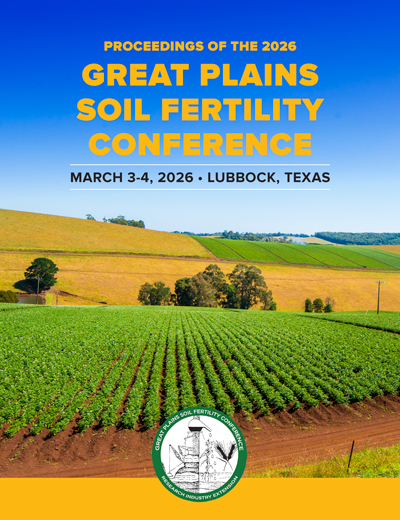
Conference Proceedings Available!

 
The 2026 Great Plains Soil Fertility Conference Proceedings Book is now available! Click the link below to view the full document!
 
2026_GPSFC_Proceedings.pdf

Proceedings

Find matching any: Reset
Lamb, P
Manter, D.K
Motal, F
KELLEY, J
Add filter to result:
Authors
Delgado, J.A
Floyd, B
D'Adamo, R
Villacis, A
Brandt, A.D
Halvorson, A
Stewart, C.E
Alwang, J
Del Grosso, S
Manter, D.K
Miller, P
Jones, C
Atencio, S
Chen, C
Eriksmoen, E
Fordyce, S
Lamb, P
Ostlie, M
Rickertsen, J
Grusak, M.A
Bourgault, M
Franck, B
Carr, P
Koeshall, S
Baber, K
Roper, W
Acosta-Martinez, V
Moore, J
Mikha, M
Manter, D.K
Stewart, C.E
Lehman, R.M
Liebig, M.A
Jin, V.L
Silva, J
Drescher, G
Roberts, T
KELLEY, J
Smartt, A
Sarfaraz, Q
RONGEY, W
Andrade Leite Mengez, G
Ramos do Prado, M
Stewart, C.E
Manter, D.K
Del Grosso, S
Miner, G
Kleinman, P
Topics
Environment and Soil
Nutrient Management and Analysis
General
Student
General
Type
Oral
Poster
Year
2022
2024
2026
Home » Authors » Results

Authors

Filter results5 paper(s) found.

1. Effects of Climate Change and Narrow Rows with Higher Plant Densities on Yields of Irrigated Corn

Climate change is significantly impacting agricultural systems worldwide, and although there are reports of these impacts contributing to higher yields in some regions, the general consensus is that there will be negative impacts on yields and soil quality across large regions.  Management practices that can contribute to higher yields and adaptation to a changing climate will be important during the 21st century. This presentation will cover results from two manuscripts that are currently... J.A. Delgado, B. Floyd, R. D'adamo, A. Villacis, A.D. Brandt, A. Halvorson, C.E. Stewart, J. Alwang, S. Del grosso, D.K. Manter

2. Lentil Inoculant, Potassium, Sulfur, and Micronutrient Effects on Yield and Protein in the Northern Great Plains

Lentil (Lens culinaris Medikus) is an important crop, averaging more than 600,000 ac in MT and ND from 2016-20. However, relatively little is known about inoculant and fertility response in lentil in the U.S. northern Great Plains. The objective of this experiment was to evaluate the effect of rhizobial inoculant formulations (granular and seed-coat) and nutrient additions (K, S, and micronutrients), on lentil growth, yield, and seed protein. This study was conducted at six or seven university... P. Miller, C. Jones, S. Atencio, C. Chen, E. Eriksmoen, S. Fordyce, P. Lamb, M. Ostlie, J. Rickertsen, M.A. Grusak, M. Bourgault, B. Franck, P. Carr, S. Koeshall, K. Baber

3. Soil Microbes Are Critical to Maintaining Soil Fertility in the Great Plains

Soil in the Great Plains is known to be susceptible to wind and water erosion due to moisture deficits throughout the region that limit soil organic matter (SOM) accumulation that helps form stable soil structure. Conservation management practices like reduced tillage are emphasized to maintain SOM that provides habitat for soil microbes to perform ecosystem services related to nutrient cycling and soil aggregation to increase resistance to erosion and maintain fertile topsoil. Soils under long-term... W. Roper, V. Acosta-martinez, J. Moore, M. Mikha, D.K. Manter, C.E. Stewart, R.M. Lehman, M.A. Liebig, V.L. Jin

4. Defining Critical Tissue-Potassium Concentrations for Furrow Irrigated Corn Production

Potassium (K) is a critical nutrient for adequate corn (Zea mays L.) production, and tissue testing is an essential tool to ensure adequate K nutrition. Despite the important role of K in plant physiological functions, there are no calibrated critical tissue-K concentrations (TKc) for furrow-irrigated corn in Arkansas. This study aimed to define critical TKc values to maximize corn grain yield across different growth stages. From 2022 to 2024, twelve single-site-year and four long-term... J. Silva, G. Drescher, T. Roberts, J. Kelley, A. Smartt, Q. Sarfaraz, W. Rongey, G. Andrade leite mengez, M. Ramos do prado

5. Stacking Regenerative Agricultural Practices Under Irrigated Forage Production

Incorporation of forage production into producer landscapes is an opportunity to hedge economic risk and increase yield stability. Regenerative agricultural management practices that also reduce N fertilizer and pest control costs, recycle nutrients, and preserve and capture precipitation are needed in semi-arid regions. There is little information on how the combination of regenerative practices such as no-tillage (NT) and cover crops will influence the timing and effect (e.g., additive,... C.E. Stewart, D.K. Manter, S. Del grosso, G. Miner, P. Kleinman