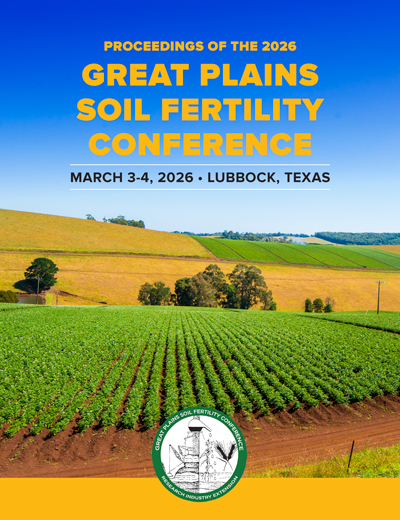
Conference Proceedings Available!

 
The 2026 Great Plains Soil Fertility Conference Proceedings Book is now available! Click the link below to view the full document!
 
2026_GPSFC_Proceedings.pdf

Proceedings

Find matching any: Reset
Harold, S
Heer, W
Holman, J
Gross, T
D'Adamo, R
Griffith, D
Add filter to result:
Authors
Delgado, J.A
Halvorson, A
Villacis-Aveiga, A
Del Grosso, S
Stewart, C
Manter, D
Alwang, J
Floyd, B
D'Adamo, R
Miner, G
Obour, A
Holman, J
Simon, L
Schlegel, A
Holman, J
Obour, A
Schlegel, A
Simon, L
Simon, L
Obour, A
Holman, J
Roozeboom, K
Delgado, J.A
Floyd, B
D'Adamo, R
Villacis, A
Brandt, A.D
Halvorson, A
Stewart, C.E
Alwang, J
Del Grosso, S
Manter, D.K
Lim, C
Chen, C
Kowatch-Carlson, C
Franck, B
Gross, T
Brown, R
Etesami, M
ETEMADI, F
Gross, T
Franck, B
Chen, C
Kowatch-Carlson, C
Franck, S
Topics
Soil Management
Environment and Soil
General Posters
General
Type
Oral
Poster
Year
2020
2022
2024
Home » Authors » Results

Authors

Filter results7 paper(s) found.

1. Assessment of Long-term Effects of Tillage and Nitrogen Management Practices on Irrigated Corn Yields and Nitrogen Use Efficiencies

Corn grain yields and crop nitrogen uptake are affected by management factors such as tillage intensity and nitrogen rates. Additional data about the long-term effects of tillage and nitrogen rates on yields and nitrogen use efficiencies of irrigated corn are needed. We are presenting preliminary results from a 17-year study about the effects of these management practices on irrigated corn yields and nitrogen uptake in a Fort Collins clay loam soil at Colorado State University’s Agricultural... J.A. Delgado, A. Halvorson, A. Villacis-aveiga, S. Del grosso, C. Stewart, D. Manter, J. Alwang, B. Floyd, R. D'adamo, G. Miner

2. Strategic Tillage Effects on Crop Yield and Soil Properties and Dryland Crop Rotations

This study evaluated strategic tillage (ST) to control HR weeds and improve crop yields in an otherwise long-term no-till (NT) soil. Treatments were five crop rotations: 1) continuous winter wheat (Triticum aestivum L.) (WW); 2) wheat-fallow (WF); 3) wheat-sorghum (Sorghum bicolor L.)-fallow (WSF); 4) continuous sorghum (SS); and 5) sorghum-fallow (SF) as main plots. The sub-plot were reduced tillage (RT), continuous NT, and ST of NT. Results showed tillage (ST or RT)... A. Obour, J. Holman, L. Simon, A. Schlegel

3. Long-term Forage Rotation Yields, Soil Water Use, and Profitability

Forages are important for the region’s livestock industry and are becoming increasingly important as irrigation capacity and grain prices decrease. Forages require less water than grain crops and may allow for increasing cropping system intensification and opportunistic cropping. A study was initiated in 2012 at the Southwest Research-Extension Center near Garden City, KS, comparing several 1-, 3-, and 4-year forage rotations with no-tillage and minimum-tillage. Data presented are from 2013... J. Holman, A. Obour, A. Schlegel, L. Simon

4. Long-term Cover Crop Effects on Soil Organic Carbon, Nitrogen Stocks, and Water Stable Aggregates in the Semiarid Central Great Plains

Growing cover crops (CC) in semiarid dryland cropping systems in the central Great Plains (CGP) may provide several benefits to soil health. This study examined long-term CC management effects on soil health in a no-till winter wheat (Triticum aestivum L.)–grain sorghum (Sorghum bicolor L.)–fallow (WSF) cropping system in southwestern Kansas. The experimental design was a split-split-plot randomized complete block with four replications. Main plots were... L. Simon, A. Obour, J. Holman, K. Roozeboom

5. Effects of Climate Change and Narrow Rows with Higher Plant Densities on Yields of Irrigated Corn

Climate change is significantly impacting agricultural systems worldwide, and although there are reports of these impacts contributing to higher yields in some regions, the general consensus is that there will be negative impacts on yields and soil quality across large regions.  Management practices that can contribute to higher yields and adaptation to a changing climate will be important during the 21st century. This presentation will cover results from two manuscripts that are currently... J.A. Delgado, B. Floyd, R. D'adamo, A. Villacis, A.D. Brandt, A. Halvorson, C.E. Stewart, J. Alwang, S. Del grosso, D.K. Manter

6. Effect of Soil and Foliar Application of Sulfur, Magnesium, Boron, and Zinc on Root Yield and Sugar Quality in Conventional Till and No Till Sugar Beet

Field experiment was conducted at the Eastern Agricultural Research Center in Sidney, MT, to determine the effect of S, Mg, B, and Zn on beet yield and sugar quality under conventional and no-till system. Split-plot design was used with 3.6 x 9.1 m experimental plots and four replicates. Tillage was main plot and micronutrient fertilizer was sub-plot. Tillage treatments included conventional and no-till. Fertilizer treatments included SUL4R-PLUS® (Ca & S), SUL4R-PLUS®B+Zn... C. Lim, C. Chen, C. Kowatch-carlson, B. Franck, T. Gross, R. Brown

7. Nitrogen Fertilizer and Rhizobium Combinations to Improve Yield and Quality of Mung Bean and Adzuki Bean in Montana

Mung bean and adzuki bean are new alternative grain legumes that may be grown in Montana and provide benefits to Montana’s cropping systems by improving long-term diversification and productivity. The objective of this study was to investigate mung bean and adzuki bean response to nitrogen fertilizer and rhizobium combinations to determine the optimum fertilizer management. Two adzuki bean (Organic and O.R varieties) and two mung bean (Organic and L.N varieties) cultivars were grown under... M. Etesami, F. Etemadi, T. Gross, B. Franck, C. Chen, C. Kowatch-carlson, S. Franck