Conference Proceedings Available!
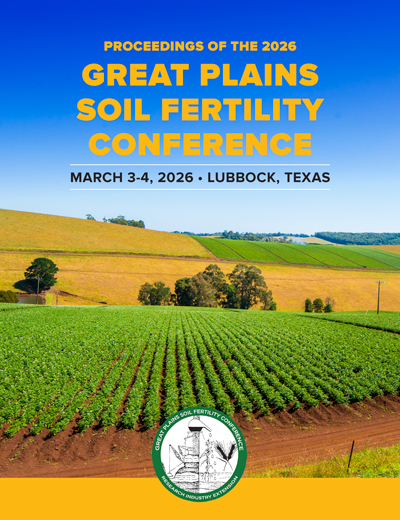
 
The 2026 Great Plains Soil Fertility Conference Proceedings Book is now available! Click the link below to view the full document!
 
2026_GPSFC_Proceedings.pdf

Proceedings

Find matching any: Reset
DeLaune, P
Harapiak, J
Deibert, E
Del Grosso, S
Add filter to result:
Authors
DeLaune, P
Lewis, K
Mubvumba, P
McDonald, M
DeLaune, P
Gentry, T
Lewis, K
Del Grosso, S
Derner, J
Delgado, J
Boogades, N
Lewis, K
Gentry, T
DeLaune, P
Ellman-Stortz, L.M
Burke, J
Lewis, K
DeLaune, P
Boogades, N
Lewis, K
Cobos, C
Burke, J
DeLaune, P
Cobos, C
Baath, G
Burke, J
Chatterjee, S
DeLaune, P
Lewis, K
Stewart, C.E
Manter, D.K
Del Grosso, S
Miner, G
Kleinman, P
Topics
Cover Crops and Nutrients
Environment and Soil
General Posters
Conservation Impacts on Soil Health
Student
General
Type
Oral
Poster
Year
2020
2022
2024
2026
Home » Authors » Results

Authors

Filter results8 paper(s) found.

1. Nitrogen Availability Following Cover Crops in TX Cropping Systems

Cover crops have been heavily promoted to improve soil health and function in US agricultural productions systems. Within semi-arid environments, interest in cover crops continues to grow although several concerns hinder adoption. As soil water use by cover crops is often a chief concern, nutrient availability to subsequent crops is also a concern. The objective of this study was to measure soil chemical and biological properties following various cover crops in a continuous cotton system under... P. Delaune, K. Lewis, P. Mubvumba

2. Conservation Management and Nitrogen Fertilization to Enhance Soil Chemical and Biological Properties  

Cover crops and no-tillage are increasing in use across Texas. On the Southern High Plains (SHP) these practices are important mitigators of wind erosion and are suggested to increase soil health and other positive soil attributes. This study aimed to monitor and evaluate the soil chemical and biological changes that occur shortly after implementing conservation practices  and nitrogen management strategies on the SHP. It was determined that in the short term some soil chemical and biological... M. Mcdonald, P. Delaune, T. Gentry, K. Lewis

3. Legacy Impacts of Cattle Grazing on Soil N2O and CH4 Fluxes in Shortgrass Steppe

Grazing cattle directly emit CH4 from enteric fermentation and contribute to soil N gas emissions related to nitrogen and organic matter additions from urine and manure deposits. Grazed soils can be sources or sinks of CH4, depending on moisture levels and localized manure patches. N2O emissions are related to availability of water as well as mineral N and labile C substrates in soil. Previously, we observed higher N2O and NH3 losses from fresh patches of urine and manure compared to... S. Del grosso, J. Derner, J. Delgado

4. Soil Health Comparison in Organic and Conventional Cotton-Peanut Rotations in the Texas Plains Region

 Organic farming has been increasingly adopted in the Texas High Plains (THP), but restrictions on synthetic fertilizer use may be problematic if a system cannot mineralize sufficient nutrients from organic matter breakdown to meet crop needs. Cover crops are a tool utilized by both organic and conventional producers for nutrient management, weed control and soil conservation. A one-year study was conducted in organic peanuts in Lubbock and Vernon, TX, to assess the ability of cover crops... N. Boogades, K. Lewis, T. Gentry, P. Delaune, L.M. Ellman-stortz

5. Soil Health and Cotton Production in the Semi-arid Texas High Plains

Soil health has become a ubiquitous term in agriculture, but little is known about the impact of cropping system management on soil health metrics in semi-arid regions because of the majority of research has been conducted in humid or sub-humid regions of the United States. As a leading commodity of the semi-arid Southwest, cotton is an ideal candidate for soil health review. The purpose of this study was to assess a proposed set of soil health metrics in cotton production on the semi-arid Texas... J. Burke, K. Lewis, P. Delaune

6. Carbon and Nutrient Dynamics in Regenerative Cotton Production Systems of the Texas Southern High Plains

Carbon (C) sequestration in soil provides environmental and agronomic benefits. However, building soil C in semi-arid cotton systems is difficult due to low rainfall, low biomass production and high temperatures. Regenerative systems, which utilize practices such as cover cropping and crop rotation, can increase the amount of C input in cotton (Gossypium hirsutum) production systems, but they may increase C losses via carbon dioxide (CO2) due to increased respiration from soil... N. Boogades, K. Lewis, C. Cobos, J. Burke, P. Delaune

7. Cover Crop Termination Timing Effects on Soil and Cotton Nutrient Availability

Cover crop termination timings can have large impacts on the amount of soil coverage, nutrient availability, and stored soil moisture in a system. Producers in semi-arid regions must gamble the possibility of increased soil infiltration and reduced soil water evaporation against the potential of decreased soil moisture; in the SHP, success is dependent on irrigation capacity and precipitation. Optimizing termination timings for semi-arid regions and in deficit-irrigation/dryland systems is critical... C. Cobos, G. Baath, J. Burke, S. Chatterjee, P. Delaune, K. Lewis

8. Stacking Regenerative Agricultural Practices Under Irrigated Forage Production

Incorporation of forage production into producer landscapes is an opportunity to hedge economic risk and increase yield stability. Regenerative agricultural management practices that also reduce N fertilizer and pest control costs, recycle nutrients, and preserve and capture precipitation are needed in semi-arid regions. There is little information on how the combination of regenerative practices such as no-tillage (NT) and cover crops will influence the timing and effect (e.g., additive,... C.E. Stewart, D.K. Manter, S. Del grosso, G. Miner, P. Kleinman