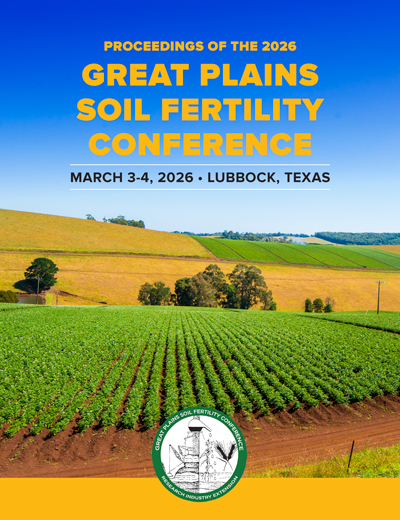
Conference Proceedings Available!

 
The 2026 Great Plains Soil Fertility Conference Proceedings Book is now available! Click the link below to view the full document!
 
2026_GPSFC_Proceedings.pdf

Proceedings

Find matching any: Reset
Detter, N
Villacis, A
Doesken, K
Harold, J
Abdelhamid, M
Add filter to result:
Authors
Delgado, J.A
Floyd, B
D'Adamo, R
Villacis, A
Brandt, A.D
Halvorson, A
Stewart, C.E
Alwang, J
Del Grosso, S
Manter, D.K
Chen, C
Etesami, M
Abdelhamid, M
Holman, J
Detter, N
Obour, A
Tamea, P
Holman, J
Detter, N
Obour, A
Haag, L
Roozeboom, K
Topics
Environment and Soil
General
Type
Oral
Poster
Year
2022
2024
Home » Authors » Results

Authors

Filter results4 paper(s) found.

1. Effects of Climate Change and Narrow Rows with Higher Plant Densities on Yields of Irrigated Corn

Climate change is significantly impacting agricultural systems worldwide, and although there are reports of these impacts contributing to higher yields in some regions, the general consensus is that there will be negative impacts on yields and soil quality across large regions.  Management practices that can contribute to higher yields and adaptation to a changing climate will be important during the 21st century. This presentation will cover results from two manuscripts that are currently... J.A. Delgado, B. Floyd, R. D'adamo, A. Villacis, A.D. Brandt, A. Halvorson, C.E. Stewart, J. Alwang, S. Del grosso, D.K. Manter

2. Combined Nitrogen with Magnesium or Zinc Effects on Sugarbeet Yield Sucrose Concentration, and Nutrient Uptake Under Conventional and No-till Systems

Sugar beet (Beta vulgaris L.) is an important cash crop in the Lower Yellowstone River valley. Fertility, especially nitrogen (N) fertilizer, management is critical for sugar beet yield and sucrose concentration.  While farmers are switching from a conventional tillage method to a no-till system for sugar beet cultivation, nitrogen (N) fertilizer application timing might need to be adjusted. Furthermore, micronutrients may enhance sugar beet yield and sucrose concentration. A two-year... C. Chen, M. Etesami, M. Abdelhamid

3. Effect of Seeding Rate on Annual Warm Season Forage Yield and Plant Structure

Due to the decline of the Ogallala Aquifer and reduced irrigation capacity, there is growing interest in more water-efficient cropping systems in the semi-arid central Great Plains. To support the region’s livestock industry, there is increased interest in forages because they use water more efficiently than grain crops. However, there is insufficient information on summer annual forage seeding rates in the range of environments encountered in the region. The objective of this study was... J. Holman, N. Detter, A. Obour, P. Tamea

4. Summer Annual Legumes: Yield Potential and Water Use

Due to the decline of the Ogalla Aquifer and reduced irrigation capacity, there is a growing interest in more water-efficient cropping systems in the semi-arid central Great Plains. One of the most water-intense crops grown on the semi-arid central Great Plains is alfalfa (Medicago sativa L.). Alfalfa is grown for its nutritive value and protein, which is highly desired by cow/calf, feed yards, and dairies of the central and southern Great Plains. The purpose of this study was to evaluate... J. Holman, N. Detter, A. Obour, L. Haag, K. Roozeboom