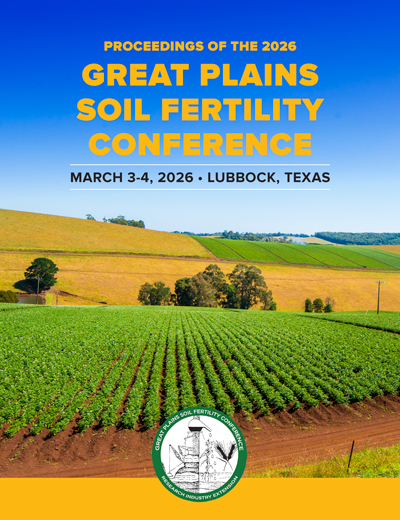
Conference Proceedings Available!

 
The 2026 Great Plains Soil Fertility Conference Proceedings Book is now available! Click the link below to view the full document!
 
2026_GPSFC_Proceedings.pdf

Proceedings

Find matching any: Reset
Jones, C
Franzen, D
Tanaka, D
Olsen, S
Add filter to result:
Authors
Jones, C
Miller, P
Zabinski, C
D'Agati, K
Wick, A
Franzen, D
Goettl, B
Baber, K
Jones, C
Miller, P
Koeshall, S
Jones, C
Miller, P
Zabinski, C
Fouts, W
Miller, P
Jones, C
Atencio, S
Chen, C
Eriksmoen, E
Fordyce, S
Lamb, P
Ostlie, M
Rickertsen, J
Grusak, M.A
Bourgault, M
Franck, B
Carr, P
Koeshall, S
Baber, K
Rakkar, M
Jones, C
Miller, P
McVay, K
Engel, R
Franzen, D
Goettl, B
Topics
Cover Crops and Nutrients
Nitrogen Management
Conservation Impacts on Soil Health
Nutrient Management and Analysis
General
Type
Oral
Poster
Year
2020
2022
2024
Home » Authors » Results

Authors

Filter results7 paper(s) found.

1. Soil Quality and Nitrogen Availability After Eight Years of a Mixed Cover Crop - Wheat Rotation

Despite a large interest in cover crops in the northern Great Plains, little is known about their effect on both the following wheat crop and soil quality. In 2012, a cover crop study was started in Montana to compare wheat production and soil quality after growing cover crop mixes containing 2-, 6-, or 8-species, with both summer fallow and a sole pea cover crop control, in a 2-yr rotation with wheat. The 2-species mixes represented functional groups (legumes, brassicas, tap rooted, or fibrous... C. Jones, P. Miller, C. Zabinski, K. D'agati

2. Nitrogen Response of 2-Row Barley in North Dakota

In about 2019, the major malting barley buyers moved from 6-row barley cultivars to 2-row barley cultivars. The N response of 6-row barley was well-established, however, little local data regarding 2-row cultivar N response was available. A 2-year study was conducted in North Dakota on two sites, using two cultivars at each site. Rates of N from 0 to 160 pounds N per acre were imposed on each cultivar. One site was in a long-term (30+ years) no-till system, while the other site was in a transitional... A. Wick, D. Franzen, B. Goettl

3. Lentil Nitrogen Fixation Response to Fertilizer and Inoculant in the Northern Great Plains

Lentil production in the semi-arid northern Great Plains has increased dramatically over the past two decades, providing agroecosystem benefits of efficient water use, pest cycle disruption, and biological nitrogen (N) fixation. Through N fixation, lentil may help alleviate soil acidification and groundwater contamination by reducing N fertilizer needs. Despite widespread farmer adoption of lentil in the region, little is known about the benefits of fertilizer or inoculant type concerning N fixation.... K. Baber, C. Jones, P. Miller, S. Koeshall

4. Dramatic Soil Health Changes After 18 Years of Different Nitrogen Rates and Cropping Systems in the Northern Great Plains

Relatively few long-term cropping and nitrogen rates studies have been conducted in the semi-arid northern Great Plains that assess soil health changes. A cropping system study was initiated in 2002 in Bozeman, Montana (~400 mm annual precipitation) with wheat grown in even years, and either tilled fallow or one of the following no-till systems in odd years: fallow, wheat, pea grain, pea hay, pea green manure, and an alfalfa-grass (until 2012) followed by pea grain. N was applied at either 50%... C. Jones, P. Miller, C. Zabinski, W. Fouts

5. Lentil Inoculant, Potassium, Sulfur, and Micronutrient Effects on Yield and Protein in the Northern Great Plains

Lentil (Lens culinaris Medikus) is an important crop, averaging more than 600,000 ac in MT and ND from 2016-20. However, relatively little is known about inoculant and fertility response in lentil in the U.S. northern Great Plains. The objective of this experiment was to evaluate the effect of rhizobial inoculant formulations (granular and seed-coat) and nutrient additions (K, S, and micronutrients), on lentil growth, yield, and seed protein. This study was conducted at six or seven university... P. Miller, C. Jones, S. Atencio, C. Chen, E. Eriksmoen, S. Fordyce, P. Lamb, M. Ostlie, J. Rickertsen, M.A. Grusak, M. Bourgault, B. Franck, P. Carr, S. Koeshall, K. Baber

6. Lime Management in the Semi-arid Regions of the US

Soil acidity is increasing in the semi-arid regions of the US; however, questions exist about the efficacy of different liming products to raise soil pH and how long the lime benefits last. Therefore, we conducted two studies: 1) To monitor the efficacy of three liming products: sugarbeet lime (tilled and non-tilled), prilled lime (seed-placed), and aglime (tilled) to improve soil pH and crop yields at two sites in Montana and 2) To evaluate how different sugarbeet lime rates perform to mitigate... M. Rakkar, C. Jones, P. Miller, K. Mcvay, R. Engel

7. Recent 2-Row Malting Barley Nitrogen Rate Revision for North Dakota

As the demand of two-row malting barley (Hordeum vulgare L.) increases, having sound nitrogen (N) recommendations is increasingly necessary. Not only does N play a role in grain yield, but it may also significantly impact grain malting characteristics including protein, plump, and test weight. To determine the impacts N rate and N availability have on two-row malting barley, two experimental sites were established in both Spring 2020 and 2021. The experiments were organized as a randomized... D. Franzen, B. Goettl