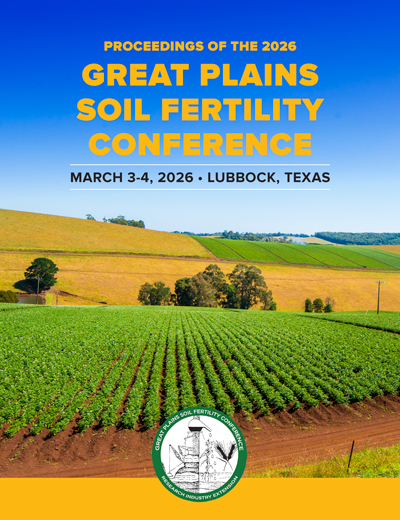
Conference Proceedings Available!

 
The 2026 Great Plains Soil Fertility Conference Proceedings Book is now available! Click the link below to view the full document!
 
2026_GPSFC_Proceedings.pdf

Proceedings

Find matching any: Reset
Vigil, M
Obour, A
Harapiak, J
Harrold, S
Add filter to result:
Authors
Del Grosso, S.J
Delgado, J
Manter, D
Stewart, C
Vigil, M
Obour, A
Holman, J
Simon, L
Schlegel, A
Holman, J
Obour, A
Schlegel, A
Simon, L
Simon, L
Obour, A
Holman, J
Roozeboom, K
Mauler, P
Holman , J
Obour , A
Simon, L
Roozeboom , K
Obour, A
Holman, J
Simon, L
Assefa, Y.M
Holman, J
Detter, N
Obour, A
Haag, L
Roozeboom, K
Simon, L
Obour, A
Holman, J
Johnson, S.K
Schwartze, J
Ruiz Diaz, D
Obour, A
Holman, J
Brian, O
Reiman, M
Rosa, A
Obour, A
Carson, Z
Akporsoe, P
Simon, L
Holman, J
Akporsoe, P
Obour, A
Holman, J
Harmoney, K
Carson, Z
Simon, L
Ruiz Diaz, D
Topics
Soil Management
General Posters
General
General
Student
Type
Oral
Poster
Year
2020
2022
2024
2026
Home » Authors » Results

Authors

Filter results11 paper(s) found.

1. Observational and Modeling Methods to Inform Ecosystem Service Markets

Interest in quantifying the impacts of land management on ecosystem services has grown as governments, environmental organizations, and corporations have pledged to reduce greenhouse gas emissions, nutrient leaching, and other environmental impacts of human activities. Ecosystem service markets were formalized in the 1990s and originally deployed to mitigate point sources of air and water pollution. Associated protocols were fairly simple and easy to implement because quantification of point sources... S.J. Del grosso, J. Delgado, D. Manter, C. Stewart, M. Vigil

2. Strategic Tillage Effects on Crop Yield and Soil Properties and Dryland Crop Rotations

This study evaluated strategic tillage (ST) to control HR weeds and improve crop yields in an otherwise long-term no-till (NT) soil. Treatments were five crop rotations: 1) continuous winter wheat (Triticum aestivum L.) (WW); 2) wheat-fallow (WF); 3) wheat-sorghum (Sorghum bicolor L.)-fallow (WSF); 4) continuous sorghum (SS); and 5) sorghum-fallow (SF) as main plots. The sub-plot were reduced tillage (RT), continuous NT, and ST of NT. Results showed tillage (ST or RT)... A. Obour, J. Holman, L. Simon, A. Schlegel

3. Long-term Forage Rotation Yields, Soil Water Use, and Profitability

Forages are important for the region’s livestock industry and are becoming increasingly important as irrigation capacity and grain prices decrease. Forages require less water than grain crops and may allow for increasing cropping system intensification and opportunistic cropping. A study was initiated in 2012 at the Southwest Research-Extension Center near Garden City, KS, comparing several 1-, 3-, and 4-year forage rotations with no-tillage and minimum-tillage. Data presented are from 2013... J. Holman, A. Obour, A. Schlegel, L. Simon

4. Long-term Cover Crop Effects on Soil Organic Carbon, Nitrogen Stocks, and Water Stable Aggregates in the Semiarid Central Great Plains

Growing cover crops (CC) in semiarid dryland cropping systems in the central Great Plains (CGP) may provide several benefits to soil health. This study examined long-term CC management effects on soil health in a no-till winter wheat (Triticum aestivum L.)–grain sorghum (Sorghum bicolor L.)–fallow (WSF) cropping system in southwestern Kansas. The experimental design was a split-split-plot randomized complete block with four replications. Main plots were... L. Simon, A. Obour, J. Holman, K. Roozeboom

5. Soil Properties Affected by Grazing and Tillage of Annual Forages

No-till (NT) management of annual crop production systems increases precipitation capture and storage. However, compaction with annual livestock grazing and the development of herbicide resistant weeds present challenges to long-term NT. An on-farm study was established in 2016 near Jetmore, KS to investigate the influence of annual tillage with a sweep plow compared to NT in a grazed continuous winter triticale production system. Forage productivity as well as weed density and soil properties... P. Mauler, J. Holman , A. Obour , L. Simon, K. Roozeboom

6. Soil Properties and Winter Wheat Nutrient Uptake As Affected by Long-term Tillage and Nitrogen Fertilization

Knowledge gained on the long-term effects of crop management practices on soil fertility is critical in developing nutrient management strategies to optimize crop yields and environmental sustainability in semi-arid cropping systems. This study examined the long-term effects of nitrogen (N) fertilizer management and tillage intensity [conventional tillage (CT), and no-tillage (NT)] on soil properties and nutrient uptake in a dryland wheat-sorghum-fallow cropping system. Results showed winter wheat... A. Obour, J. Holman, L. Simon, Y.M. Assefa

7. Summer Annual Legumes: Yield Potential and Water Use

Due to the decline of the Ogalla Aquifer and reduced irrigation capacity, there is a growing interest in more water-efficient cropping systems in the semi-arid central Great Plains. One of the most water-intense crops grown on the semi-arid central Great Plains is alfalfa (Medicago sativa L.). Alfalfa is grown for its nutritive value and protein, which is highly desired by cow/calf, feed yards, and dairies of the central and southern Great Plains. The purpose of this study was to evaluate... J. Holman, N. Detter, A. Obour, L. Haag, K. Roozeboom

8. Post-wheat Summer Cover Crop Effects Crop Yields and Soil Properties in a No-till Dryland Cropping System

Traditional dryland cropping systems in the semi-arid Great Plains include long fallow periods of up to 14 months to conserve soil moisture. However, such systems are inefficient even under continuous no-till (NT) management. As less water is necessary to produce forage compared to grain, cover crops (CCs) may be successfully integrated into dryland crop rotations for increased soil cover and potentially greater income when hayed or grazed as annual forages. One study was initiated in 2016 near... L. Simon, A. Obour, J. Holman, S.K. Johnson

9. Impacts of Crop Management on Grain Yield, Grain Quality, Cover Crop Biomass, Residue Cover, and Residual Nitrogen in Dryland Systems

Crop production depends on interactions among management practices, yet most studies evaluate the effect of individual practices rather than their interaction. This field experiment was established in 2024 at the Kansas State University Harold and Olympia Lonsinger Sustainability Farm (Osborne County, Kansas) to assess how combinations of common practices affect crop productivity and soil properties in a dryland system Treatments were a factorial combination of crop rotations (continuous... J. Schwartze, D. Ruiz diaz, A. Obour, J. Holman, O. Brian, M. Reiman, A. Rosa

10. Cover Crop Planting Time Effects on Biomass Productivity, Soil Health and Wheat Yield in Dryland Systems

Ecosystems benefits of cover crops (CCs) in semi-arid dryland cropping systems are dependent on CC biomass productivity. This study evaluated how CC planting time (spring vs. fall) and fallow management practices [no-tillage (NT) vs. occasional tillage (OT)] influenced CC biomass, surface residue, selected soil health properties and crop yields in within a winter wheat (Triticum aestivum L.)-sorghum (Sorghum bicolor Moench)–fallow (WSF) rotation. The experiment was conducted from... A. Obour, Z. Carson, P. Akporsoe, L. Simon, J. Holman

11. Short-Term Changes in Soil Properties Following Simulated Wildfire After Winter Wheat Harvest

Wildfires on croplands can destroy residue cover, soil organic matter and negatively impact crops yields in semi-arid Great. Approximately 16 acre field of winter wheat stubble was subjected to wildfire event at Kansas State University Agricultural Research Center near Hays, KS  to study management strategies that can restore soil health in croplands impacted by wildfires.  Control burning to stimulated wildfire was done in summer 2025 by igniting fire on a down-wind corner at the interface... P. Akporsoe, A. Obour, J. Holman, K. Harmoney, Z. Carson, L. Simon, D. Ruiz diaz