Conference Proceedings Available!
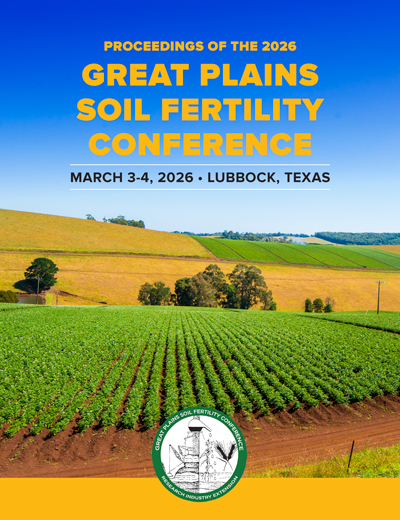
Proceedings
Authors
| Filter results8 paper(s) found. |
|---|
1. Nitrogen Fertilization and Long-term No-tillage Impacts on Soil Properties and Deep Soil C Storage Under IrrigationThe net soil greenhouse gas mitigation potential of conservation agricultural management practices is strongly influenced by the direction and magnitude of soil organic C (SOC) change in deep soil layers (>6”). Deep SOC is typically old, highly processed, and consists of microbial products and root exudates associated with clay and other minerals. However, it can be susceptible to decomposition and priming from the addition of new, labile organic C. We examined long-term soil C dynamics... C. Stewart, D. Manter, J. Delgado, S. Del Grosso, F. Calderon, K. Heckman, K. Snell |
2. Nutrient Cycling Following Cover Crop Termination in Texas Cotton ProductionCover crop adoption on the Texas High Plains (THP) is severely limited compared to other agricultural regions in the U.S. Cotton producers on the THP consistently site water limitations as the primary reason for not implementing cover crops in their cropping systems. Previous research on the THP has shown that nitrogen immobilization following cover crop termination might be the most leading consequence of cover crops, not water availability. A study was initiated into existing long term... J.A. Burke, K.L. Lewis, J.L. Foster |
3. Legacy Impacts of Cattle Grazing on Soil N2O and CH4 Fluxes in Shortgrass SteppeGrazing cattle directly emit CH4 from enteric fermentation and contribute to soil N gas emissions related to nitrogen and organic matter additions from urine and manure deposits. Grazed soils can be sources or sinks of CH4, depending on moisture levels and localized manure patches. N2O emissions are related to availability of water as well as mineral N and labile C substrates in soil. Previously, we observed higher N2O and NH3 losses from fresh patches of urine and manure compared to... S. Del Grosso, J. Derner, J. Delgado |
4. Lentil Nitrogen Fixation Response to Fertilizer and Inoculant in the Northern Great PlainsLentil production in the semi-arid northern Great Plains has increased dramatically over the past two decades, providing agroecosystem benefits of efficient water use, pest cycle disruption, and biological nitrogen (N) fixation. Through N fixation, lentil may help alleviate soil acidification and groundwater contamination by reducing N fertilizer needs. Despite widespread farmer adoption of lentil in the region, little is known about the benefits of fertilizer or inoculant type concerning N fixation.... K. Baber, C. Jones, P. Miller, S. Koeshall |
5. Dramatic Soil Health Changes After 18 Years of Different Nitrogen Rates and Cropping Systems in the Northern Great PlainsRelatively few long-term cropping and nitrogen rates studies have been conducted in the semi-arid northern Great Plains that assess soil health changes. A cropping system study was initiated in 2002 in Bozeman, Montana (~400 mm annual precipitation) with wheat grown in even years, and either tilled fallow or one of the following no-till systems in odd years: fallow, wheat, pea grain, pea hay, pea green manure, and an alfalfa-grass (until 2012) followed by pea grain. N was applied at either 50%... C. Jones, P. Miller, C. Zabinski, W. Fouts |
6. Lentil Inoculant, Potassium, Sulfur, and Micronutrient Effects on Yield and Protein in the Northern Great PlainsLentil (Lens culinaris Medikus) is an important crop, averaging more than 600,000 ac in MT and ND from 2016-20. However, relatively little is known about inoculant and fertility response in lentil in the U.S. northern Great Plains. The objective of this experiment was to evaluate the effect of rhizobial inoculant formulations (granular and seed-coat) and nutrient additions (K, S, and micronutrients), on lentil growth, yield, and seed protein. This study was conducted at six or seven university... P. Miller, C. Jones, S. Atencio, C. Chen, E. Eriksmoen, S. Fordyce, P. Lamb, M. Ostlie, J. Rickertsen, M.A. Grusak, M. Bourgault, B. Franck, P. Carr, S. Koeshall, K. Baber |
7. Lime Management in the Semi-arid Regions of the USSoil acidity is increasing in the semi-arid regions of the US; however, questions exist about the efficacy of different liming products to raise soil pH and how long the lime benefits last. Therefore, we conducted two studies: 1) To monitor the efficacy of three liming products: sugarbeet lime (tilled and non-tilled), prilled lime (seed-placed), and aglime (tilled) to improve soil pH and crop yields at two sites in Montana and 2) To evaluate how different sugarbeet lime rates perform to mitigate... M. Rakkar, C. Jones, P. Miller, K. Mcvay, R. Engel |
8. Influence of Nitrogen Management and Precipitation on Sorghum Nitrogen Use EfficiencyGrain sorghum (Sorghum bicolor L. Moench) is a key crop in Kansas which can benefit from optimized nitrogen (N) management that enhances yield while minimizing N losses. Understanding the relationships among physiological efficiency (PE), recovery efficiency (RE), and agronomic efficiency (AE), as well as their interactions with climatic factors such as precipitation, is essential for improving nitrogen use efficiency (NUE). Experiments were conducted across five rainfed... M. Platero |