Conference Proceedings Available!

 
The 2026 Great Plains Soil Fertility Conference Proceedings Book is now available! Click the link below to view the full document!
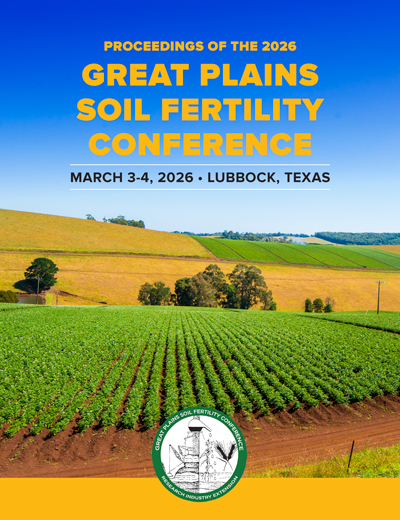
 
2026_GPSFC_Proceedings.pdf

Proceedings

Find matching any: Reset
Stewart, W
Santos, E
Schierer, R
Selles, F
Cihacek, L
Add filter to result:
Authors
Cihacek, L
Alghamdi, R
Haag, L
Tomlinson, P
Patel, S
Santos, E
Haag, L
Patel, S
Tomlinson, P
Santos, E
Topics
N Management
Environment and Soil
Nitrogen Management
Type
Oral
Year
2020
2022
Home » Authors » Results

Authors

Filter results3 paper(s) found.

1. N Mineralization Dynamics in No-till Crop Residues in the Northern Plains

Although many studies have been conducted on no-till cropping systems, little is yet known about the dynamics of N mineralization from accumulated crop residues as it relates to providing N to subsequent crops. We conducted incubation studies using individual crop residues placed on the surface of soil columns in leaching tubes and incubating the tubes for approximately 12 weeks (simulated growing season) with periodic leaching.  This was repeated 5 times with a freezing period (winter... L. Cihacek, R. Alghamdi

2. Measuring N2O Emissions from Dryland Sorghum Production Using Gas Chamber and Eddy Covariance Flux Methods

Nitrous oxide (N2O) emissions are not well quantified in the dryland production systems of the Great Plains.  Lack of field-based data has led to the use of questionable assumptions in various life-cycle analyses when dryland grain production is a feedstock.  A field-scale trial of 81 acres was established within a 160 acre production field of dryland grain sorghum in northwest Kansas in 2021.  Grain sorghum was no-till seeded into wheat stubble.  Grower practices for nitrogen... L. Haag, P. Tomlinson, S. Patel, E. Santos

3. Spatial Variability in Profile Soil Nitrate, Nutrient Update, Grain Yield, and Nutrient Removal in a Commercial Dryland Grain Sorghum Field

Established relationships exist that describe the confidence interval around a soil test value as a function of cores in the sample for nutrients such as phosphorus.  This information is useful for developing economically and agronomically optimal soil sampling strategies.  Residual soil nitrate can be a significant source of a crops N needs in dryland cropping systems where N loss is minimal. A common question among producers and consultants is how many profile N cores are required... L. Haag, S. Patel, P. Tomlinson, E. Santos