Conference Proceedings Available!
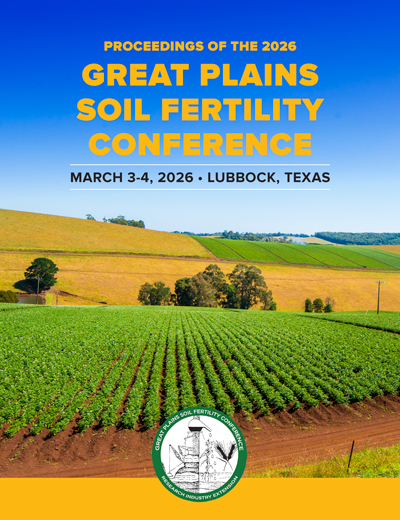
 
The 2026 Great Plains Soil Fertility Conference Proceedings Book is now available! Click the link below to view the full document!
 
2026_GPSFC_Proceedings.pdf

Proceedings

Find matching any: Reset
Baker, M
Miner, G
Bauder, S
Mikha, M
Mengel, D
Wright, S
Lollato, R.P
Bourns, M
Buchanan, C
Add filter to result:
Authors
Delgado, J.A
Halvorson, A
Villacis-Aveiga, A
Del Grosso, S
Stewart, C
Manter, D
Alwang, J
Floyd, B
D'Adamo, R
Miner, G
Mikha, M
Buchanan, C
Ippolito, J
Sexton, P
Kumar, S
Osborne, S
Brockmueller, B
Bly, A
Rops, B
Bawa, A
Bauder, S
McMaine, J
Ryan, L.P
Lollato, R.P
Haag, L
Holman, J
Baker, M
Yost, M.A
Stewart, C.E
Manter, D.K
Del Grosso, S
Miner, G
Kleinman, P
Topics
Conservation Impacts on Soil Health
General Posters
Student
General
Type
Oral
Poster
Year
2020
2022
2026
Home » Authors » Results

Authors

Filter results7 paper(s) found.

1. Assessment of Long-term Effects of Tillage and Nitrogen Management Practices on Irrigated Corn Yields and Nitrogen Use Efficiencies

Corn grain yields and crop nitrogen uptake are affected by management factors such as tillage intensity and nitrogen rates. Additional data about the long-term effects of tillage and nitrogen rates on yields and nitrogen use efficiencies of irrigated corn are needed. We are presenting preliminary results from a 17-year study about the effects of these management practices on irrigated corn yields and nitrogen uptake in a Fort Collins clay loam soil at Colorado State University’s Agricultural... J.A. Delgado, A. Halvorson, A. Villacis-aveiga, S. Del grosso, C. Stewart, D. Manter, J. Alwang, B. Floyd, R. D'adamo, G. Miner

2. Tillage and Nitrogen Rates Influenced Wheat and Sorghum Productivity

Reduced tillage (RT) or no-tillage (NT) practices and reducing fallow frequency can both decrease soil losses from wind erosion and conserve soil water in the semiarid regions of the US Great Plains. This study evaluated sorghum grain yield in 2013 and wheat grain yield in 2014 and 2015 as influenced by long-term nitrogen (N) fertilizer application rates (0, 20, 40, and 60 lb N ac- 1) and tillage intensity [clean tillage (CT), RT, and NT] in dryland winter wheat–sorghum-fallow (W-S-F) cropping... M. Mikha

3. Utilizing Long-term Organic Amendments to Improve Soil Health in Semi-arid, Grazed Grasslands

Determining soil health changes associated with long-term land application of organic amendments, such as biosolids, is important for understanding and improving overall environmental health. In 1991, a single application of biosolids were surface applied (treatment rate: 0, 2.5, 5, 10, 21, or 30 Mg ha−1) to a semi-arid grazed grassland. In 2002, a repeated application of biosolids were surface applied at the same rate to ½ of all plots. In 2018, soil samples were obtained from 0-15... C. Buchanan, J. Ippolito

4. Snapshot of Crop Nutrient Balance with Use of a Rye Cover Crop in a Corn-soybean Rotation Under Tile Drainage in Eastern South Dakota

The purpose of this study was to evaluate the effect of using a winter rye cover crop within a corn/soybean rotation (rye seeded every fall and burned down each spring) on drainage water quality, crop nutrient status, and grain yield.  Use of a winter rye cover crop to take up available N from the soil profile is a management tool that may help to lessen nutrient movement out of the soil profile while at the same time contributing to improved soil health.  Winter rye is very winter hardy... P. Sexton, S. Kumar, S. Osborne, B. Brockmueller, A. Bly, B. Rops, A. Bawa, S. Bauder, J. Mcmaine

5. Increasing Winter Wheat Grain Yield By Replicating the Management Adopted in High-Yielding Commercial Fields

Large winter wheat (Triticum aestivum) yield gaps between farmer yields and yield potential in the southern Great Plains indicate the need to improve recommendations of best management strategies to profitably bridge this gap. Many studies have been completed on individual management factors pre-determined by the individual researcher, but we are not aware of studies comparing combination of practices that producers are currently using, which would be more relevant for real-world scenarios.... L.P. Ryan, R.P. Lollato, L. Haag, J. Holman

6. Phosphorus and Potassium Impacts on Field Crop Production in the Intermountain West

Macronutrients such as phosphorus (P), potassium (K), and sulfur (S) are essential nutrients often required in large quantities for optimal plant growth, with fertilizers typically supplementing soil nutrients. Fertilizer recommendations can vary significantly depending on the source and greatly affect crop profitability. Guidelines in Utah and many other states in the region were developed decades ago and need to be reassessed. Current Utah State University (USU) Guidelines identify 15 mg kg-1,... M. Baker, M.A. Yost

7. Stacking Regenerative Agricultural Practices Under Irrigated Forage Production

Incorporation of forage production into producer landscapes is an opportunity to hedge economic risk and increase yield stability. Regenerative agricultural management practices that also reduce N fertilizer and pest control costs, recycle nutrients, and preserve and capture precipitation are needed in semi-arid regions. There is little information on how the combination of regenerative practices such as no-tillage (NT) and cover crops will influence the timing and effect (e.g., additive,... C.E. Stewart, D.K. Manter, S. Del grosso, G. Miner, P. Kleinman