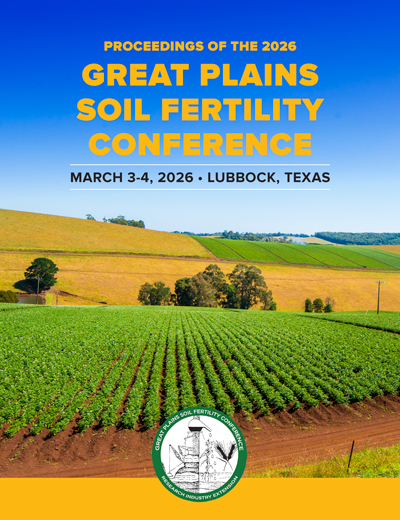
Conference Proceedings Available!
Proceedings
Authors
| Filter results4 paper(s) found. |
|---|
1. Evaluating the Trade-offs of Cover Crops in Dryland Wheat Systems of the Colorado PlateauOn the semi-arid Colorado Plateau, dryland farmers are challenged by severely degraded soils and low and increasingly unreliable precipitation. Cover crops have been shown to improve soil fertility and mitigate soil erosion in many regions, but are also associated with use of limited soil moisture, a cost that could mean decreased cash crop productivity for farmers. Most literature on cover crops comes from relatively humid climates, where crop yield penalties due to cover crops may be less pronounced.... L. Eash, A. Berrada, K. Russell, S. Fonte |
2. Water Use Efficiency and Soil Changes After Long-term Crop Rotation Under Limited IrrigationLong-term crop rotation intensity and diversity can affect key soil properties. In semi-arid regions, the combined factors of rotation and soil properties may also affect the overall water use efficiency from either limited irrigation or rainfall. The objective of this study was to evaluate changes in soil properties, and water use efficiency of corn grown under different rotation intensity and diversity and limited/supplemental irrigation. A field experiment was conducted over seven years in... D. Ruiz Diaz, P. Garcia Helguera, A. Rosa, O. Brian, K. Roozeboom |
3. Impacts of Crop Management on Grain Yield, Grain Quality, Cover Crop Biomass, Residue Cover, and Residual Nitrogen in Dryland SystemsCrop production depends on interactions among management practices, yet most studies evaluate the effect of individual practices rather than their interaction. This field experiment was established in 2024 at the Kansas State University Harold and Olympia Lonsinger Sustainability Farm (Osborne County, Kansas) to assess how combinations of common practices affect crop productivity and soil properties in a dryland system Treatments were a factorial combination of crop rotations (continuous... J. Schwartze, D. Ruiz Diaz, A. Obour, J. Holman, O. Brian, M. Reiman, A. Rosa |
4. Carbon & Nitrogen Transformation in Soil After Biosolids or Inorganic Fertilizer ApplicationBiosolids are nutrient rich organic residues which could be a potential alternative to conventional fertilizers. However, their C and N mineralization rates vary depending on treatment processes and soil properties. A laboratory incubation was carried out to evaluate C and N dynamics in contrasting soils by quantifying gaseous losses and assessing N transformations between organic and inorganic pools. Soils collected from Texas (sandy clay loam, pH: 8.4) and Florida (sandy loam, pH: 7.6) were... S. Bhatta, L. Slaughter, M. Siebecker, J. Adjei, K. Lewis, O. Gecgel, C. Alvarez-pugliese, K. Millerick, B. Rao, O. Mbuya, G.G. Botte |