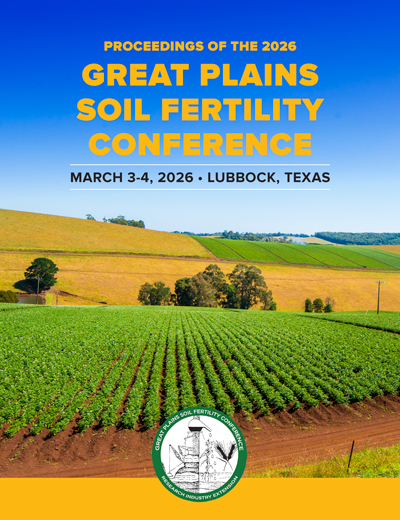
Conference Proceedings Available!
Proceedings
Authors
| Filter results4 paper(s) found. |
|---|
1. Observational and Modeling Methods to Inform Ecosystem Service MarketsInterest in quantifying the impacts of land management on ecosystem services has grown as governments, environmental organizations, and corporations have pledged to reduce greenhouse gas emissions, nutrient leaching, and other environmental impacts of human activities. Ecosystem service markets were formalized in the 1990s and originally deployed to mitigate point sources of air and water pollution. Associated protocols were fairly simple and easy to implement because quantification of point sources... S.J. Del grosso, J. Delgado, D. Manter, C. Stewart, M. Vigil |
2. Precision Mapping Technology in Dryland Cropping SystemIncreasing availability of cropland geospatial data are providing farmers with opportunities but also challenges in interpreting these data for precision cropland management decisions. The objective of this study is to evaluate spatial variability and precision management decisions using mapping technology in dryland cropping system. The study was initiated in 2018 in Akron, Colorado on field size plots ranged from 2.4 to 4.5 ha (6-11 acres) with substantial production variability. ... M.M. Mikha, D.M. Barnard, K.R. Mankin |
3. Snapshot of Crop Nutrient Balance with Use of a Rye Cover Crop in a Corn-soybean Rotation Under Tile Drainage in Eastern South DakotaThe purpose of this study was to evaluate the effect of using a winter rye cover crop within a corn/soybean rotation (rye seeded every fall and burned down each spring) on drainage water quality, crop nutrient status, and grain yield. Use of a winter rye cover crop to take up available N from the soil profile is a management tool that may help to lessen nutrient movement out of the soil profile while at the same time contributing to improved soil health. Winter rye is very winter hardy... P. Sexton, S. Kumar, S. Osborne, B. Brockmueller, A. Bly, B. Rops, A. Bawa, S. Bauder, J. Mcmaine |
4. Soil Microbes Are Critical to Maintaining Soil Fertility in the Great PlainsSoil in the Great Plains is known to be susceptible to wind and water erosion due to moisture deficits throughout the region that limit soil organic matter (SOM) accumulation that helps form stable soil structure. Conservation management practices like reduced tillage are emphasized to maintain SOM that provides habitat for soil microbes to perform ecosystem services related to nutrient cycling and soil aggregation to increase resistance to erosion and maintain fertile topsoil. Soils under long-term... W. Roper, V. Acosta-martinez, J. Moore, M. Mikha, D.K. Manter, C.E. Stewart, R.M. Lehman, M.A. Liebig, V.L. Jin |