Conference Proceedings Available!
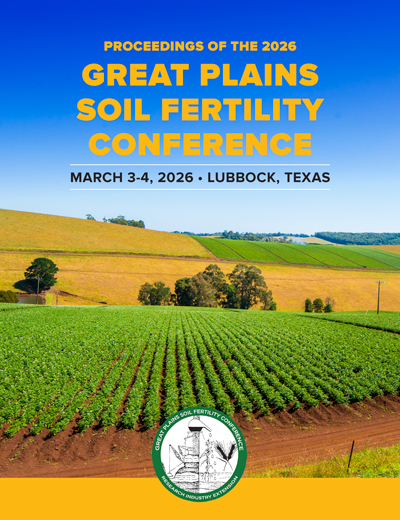
Proceedings
Topics
| Filter results23 paper(s) found. |
|---|
1. Forages and Livestock to Diversify Wheat-based Cropping SystemIntegrating annual forages and ruminant livestock to intensify dryland cropping systems have the potential to increase profitability, increase water use efficiency, and improve soil health. The objective of this study was to determine the crop yield and soil property impacts of intensifying traditional no-till winter wheat (Triticum aestivum L.)-grain sorghum (Sorghum bicolor Moench)-fallow (W-GS-F) with annual forages as well as integrating livestock. This study was initiat... Z. Carson, A. Obour, J. Holman, K. Roozeboom |
2. Impacts of Crop Management on Grain Yield, Grain Quality, Cover Crop Biomass, Residue Cover, and Residual Nitrogen in Dryland SystemsCrop production depends on interactions among management practices, yet most studies evaluate the effect of individual practices rather than their interaction. This field experiment was established in 2024 at the Kansas State University Harold and Olympia Lonsinger Sustainability Farm (Osborne County, Kansas) to assess how combinations of common practices affect crop productivity and soil properties in a dryland system Treatments were a factorial combination of crop rotations (conti... J. Schwartze, D. Ruiz Diaz, A. Obour, J. Holman, O. Brian, M. Reiman, A. Rosa |
3. Wheat Zinc Nutrition: Agronomic Biofortification That Delivers Yield and Better Grain NutritionLow Zn availability in calcareous soils is a common issue in the Canadian prairies, where much of the wheat is exported, making Canada one of the world’s largest wheat exporters. Globally, 19% of the population, mostly pregnant women, infants, and children, suffers from Zn deficiency, highlighting the need to enhance Zn bioavailability in wheat grain. Agronomic biofortification offers a promising strategy to improve grain nutrient density while optimizing plant health and development. W... M. Proulx, X. Gao |
4. Phosphorus and Potassium Impacts on Field Crop Production in the Intermountain WestMacronutrients such as phosphorus (P), potassium (K), and sulfur (S) are essential nutrients often required in large quantities for optimal plant growth, with fertilizers typically supplementing soil nutrients. Fertilizer recommendations can vary significantly depending on the source and greatly affect crop profitability. Guidelines in Utah and many other states in the region were developed decades ago and need to be reassessed. Current Utah State University (USU) Guidelines identify 15 mg kg... M. Baker, M.A. Yost |
5. Impacts of Nitrogen Rates and Enhanced Efficiency Products on Kansas CottonThe purpose of this experiment was to determine the effect that different nitrogen fertilizer rates and additives have on cotton. Response parameters included seed cotton yield and gin turnout (lint percentage), as well as fiber quality factors such as length, uniformity, micronaire, strength, and color. Nitrogen management is crucial for Kansas cotton, given its indeterminate growth and relatively short growing season. Conducting nitrogen fertilizer studies across environments to develop reg... C. Sohm, D. Ruiz Diaz, L. Simon |
6. Influence of Nitrogen Management and Precipitation on Sorghum Nitrogen Use EfficiencyGrain sorghum (Sorghum bicolor L. Moench) is a key crop in Kansas which can benefit from optimized nitrogen (N) management that enhances yield while minimizing N losses. Understanding the relationships among physiological efficiency (PE), recovery efficiency (RE), and agronomic efficiency (AE), as well as their interactions with climatic factors such as precipitation, is essential for improving nitrogen use efficiency (NUE). Experiments were conducted across five rai... M. Platero |
7. Sheep Grazing Preference and Nutrient Cycling Implications Among Cover Crop SpeciesThe vast and interspersed livestock and crop industries of Texas lend opportunity for livestock integration to benefit regional agricultural systems. Texas leads sheep production in the U.S. and small ruminant integration in crop systems has become an appealing opportunity in recent years due to strong meat markets and generally poor commodity crop markets. Many winter cover crops are likely suitable forages, and challenges of nutrient immobilization could be (at least partially) mitigated by... R. Matschek, R. Noland, N. Nielson, J. Thorne, M. Mcculloch |
8. Carbon and Nutrient Cycling in Texas Plains Regenerative CottonClimate change, drought, and economic pressures are likely to put extreme stress on agricultural production in the Texas High Plains, a region responsible for close to a third of the annual US cotton crop, over the next decade. As these threats increase, alternative production practices will need to be adopted to maintain long-term production viability in the region. A shift towards regenerative practice adoption could be a solution to this problem. Conventional cotton production involves int... N. Boogades, C. Cobos, J. Burke, K. Lewis |
9. Evaluating Charging and Inoculating Biochar Derived from Invasive Species Effects on Growth and Yield of Crops and Soil Health in Oxisol and Mollisol SoilsInvasive species like Leucaena are taking over arable-lands in Hawaii. Producing biochar using the invasive species can help with invasive species eradication, reclaiming arable-land, producing high-quality soil amendment, and improving soil health/crop productivity. Biochar is a carbon-rich amendment but it is still unclear whether biochar should be inoculated/charged before applying ... S. Meaney, A. Ahmad |
10. Defining Critical Tissue-Potassium Concentrations for Furrow Irrigated Corn ProductionPotassium (K) is a critical nutrient for adequate corn (Zea mays L.) production, and tissue testing is an essential tool to ensure adequate K nutrition. Despite the important role of K in plant physiological functions, there are no calibrated critical tissue-K concentrations (TKc) for furrow-irrigated corn in Arkansas. This study aimed to define critical TKc values to maximize corn grain yield across different growth stages. From 2022 to 2024, twelve single-site-year and four long-te... J. Silva, G. Drescher, T. Roberts, J. Kelley, A. Smartt, Q. Sarfaraz, W. Rongey, G. Andrade Leite Mengez, M. Ramos Do Prado |
11. Long-term Effects of Cover Cropping and Potassium and Phosphorus Fertilization on Soil Test Results in a Row Crop Production SystemPotassium (K) and phosphorus (P) availability can be affected by fertilizer inputs and the use of cover crops (CC) through their effects on nutrient cycling. This study aims to evaluate the long-term effects of CC and fertilizer-P and -K applications on soil-test K (STK) and soil-test P (STP) in two long-term field-scale experiments. Field trials were established in 2017 on silt-loam soils at the Lon Mann Cotton Research Station (LMCRS) and at the Rohwer Research Station (RRS), Arkansas. Each... J. Silva, G. Drescher, T. Roberts, N. Slaton, A. Smartt, Q. Sarfaraz, G. Andrade Leite Mengez, M. Ramos Do Prado |
12. Monitoring Nitrogen Transformations and Their Interaction with Potassium Uptake in Cotton Production SystemsUnderstanding the temporal dynamics of soil nitrogen (N) is critical for optimizing nutrient management in cotton production. This research monitored soil N transformations, specifically ammonium (NH₄⁺) and nitrate (NO₃⁻), throughout the cotton growing season. An additional focus was also placed on interactions between soil N forms and the uptake of essential plant nutrients, particularly potassium (K). Soil samples were collected at multiple depths and time points across different ma... J. Derrick, B. Arnall, N. Mathey, B. Oliveira Liberato, C. Camacho |
13. Genotypic Variation in Winter Wheat Yield Components Response to Nitrogen Management and Seeding DensityAchieving optimal winter wheat grain yield requires understanding genotypic variations in yield component formation under nitrogen (N) application timing and seeding density management strategies. This study evaluated whether modern winter wheat genotypes exhibit differential yield formation pathways under varying N timing and seeding rate conditions, and whether reducing N rates while increasing seeding density (or vice versa) could maintain yields while reducing input costs. Additionally, w... S. Abiola, A. Silva, S. Phillips, P.R. Abiola, B. Arnall |
14. Short-Term Changes in Soil Properties Following Simulated Wildfire After Winter Wheat HarvestWildfires on croplands can destroy residue cover, soil organic matter and negatively impact crops yields in semi-arid Great. Approximately 16 acre field of winter wheat stubble was subjected to wildfire event at Kansas State University Agricultural Research Center near Hays, KS to study management strategies that can restore soil health in croplands impacted by wildfires. Control burning to stimulated wildfire was done in summer 2025 by igniting fire on a down-wind corner at the i... P. Akporsoe, A. Obour, J. Holman, K. Harmoney, Z. Carson, L. Simon, D. Ruiz Diaz |
15. Carbon & Nitrogen Transformation in Soil After Biosolids or Inorganic Fertilizer ApplicationBiosolids are nutrient rich organic residues which could be a potential alternative to conventional fertilizers. However, their C and N mineralization rates vary depending on treatment processes and soil properties. A laboratory incubation was carried out to evaluate C and N dynamics in contrasting soils by quantifying gaseous losses and assessing N transformations between organic and inorganic pools. Soils collected from Texas (sandy clay loam, pH: 8.4) and Florida (sandy loam, pH: 7.6) were... S. Bhatta, L. Slaughter, M. Siebecker, J. Adjei, K. Lewis, O. Gecgel, C. Alvarez-pugliese, K. Millerick, B. Rao, O. Mbuya, G.G. Botte |
16. Root-Restrictive Layer Depth As a Driver of Crop Yield VariabilityEvery soil possesses unique features shaped by its genesis-factors such as parent material, climate, topography, native vegetation and time. Interactions among geological and pedological factors contribute to spatially variable soil attributes causing variability in crop yield. Root-restrictive subsurface layers are formed at varying depths in soil due to interactions among the geological and natural soil-forming factors, and sometimes due to anthropogenic causes including compaction due to h... I. Kaur, S. Phillips |
17. Raw Manure Applications Combined with Nitrogen Stabilizers to Increase Nitrogen Uptake Efficiency in Cotton Production SystemsThe Texas Southern High Plains is one of the most productive cotton-growing regions in the United States. This region is also characterized by a high density of cattle production, resulting in substantial quantities of manure that present an opportunity for integration into regional cotton nutrient management programs. Cotton production in this area is challenged by inherently low soil organic matter and low precipitation. Application of raw cattle manure has the potential to increa... N. E Curbelo, K. Lewis |
18. Maize Response to Nitrogen and Sulfur Fertilization RatesDue to reduced atmospheric deposition and advancements in agronomic management, sulfur (S) deficiency has become an increasing concern in maize production systems. Because S plays a fundamental role in nitrogen (N) metabolism, S availability may influence maize yield response to N fertilization. This study evaluated maize response to N and S fertilization rates across six locations in Oklahoma. Field experiments were conducted using a randomized complete block design with 14 treatments and fo... N. Mathey, J. Derrick, B. Arnall |
19. Evaluating the Existing Calibration Curve for Sensor-Based N Management in Grain SorghumNitrogen (N) response in grain sorghum is spatially and temporally variable, complicating estimation of optimum N rates and limiting the effectiveness of uniform fertilizer recommendations. This study evaluated within-field and year-to-year variability in N response using block-level response modeling and soil variability analysis. Field experiments were conducted in Stillwater, Oklahoma, during the 2024 and 2025 growing seasons using six N fertilizer rates (0,39, 79, 118, 157, and 196 kg N h... D. Pokharel |
20. Evaluating Side-Dress N Application Method in SorghumGrain sorghum (Sorghum bicolor L.) is a resilient cereal crop widely grown across the Great Plains, where nitrogen (N) management decisions are often constrained by equipment availability and application timing. While in-season N applications may improve flexibility for producers, concerns remain regarding potential leaf injury (“nitrogen burn”) from high-rate applications. This study evaluated the effects of N source and app... B. Arnall, C. Camacho |
21. Does Phosphorus and Potassium Timing or Rate Drive Productivity in Oklahoma Wheat-soybean Double-cropping?Wheat-soybean double cropping is an economically important system in Oklahoma and the Southern Great Plains that allows producers to maximize land productivity and profitability within a single growing season. However, the compressed soybean growing season and high nutrient demand of both crops create unique phosphorus (P) and potassium (K) management challenges not addressed by Oklahoma’s full-season recommendation. This study evaluated the effects of P and K application timing (fall, ... C. Ejezie, S. Phillips |
22. How Do Nitrogen, Irrigation, and Seeding Density Affect Corn Production?This study investigates how multispectral and thermal UAV imagery can refine nitrogen and irrigation management in a corn experiment consisting of 107 plots in the Oklahoma Panhandle. Four nitrogen rates (0, 100, 175, 250 lb N acre⁻¹), three irrigation regimes (16, 20, 24 inches), and three plant population targets (24 k, 28 k, 32 k plants acre⁻¹) are factorially arranged as a split-plot design across the field. Six UAV flights during the growing season acquire paired multispect... A. Biaou, A. Biaou |
23. Evaluation of E-Grow Effects on Soil Plant Systems Gas ExchangeE-Grow is a novel fertilizer which effect on the soil- plant system is critical for understanding it’s impact on the crop productivity and environmental sustainability in agricultural operations that will be crucial for updating nutrient application recommendations, to understand this we conducted an experiment with the main objective of this study is to determine the effect of E-Grow on CO2 and H2O fluxes in agricultural soil and soil- cotton plant systems (seedling stage). This experi... V. Sabbineni, E. Enninful, S. Jacobo, O. Gecgel, G.G. Botte, H. Laza, C. Simpson, L. Slaughter, Y. Emendack |